


What Is Gestalt Language Processing? Speech Therapy in NYC Supporting Different Communication Styles
Gestalt language processing is a hot topic in the speech-language pathology world these days. As a speech therapist in NYC, I thought I would take a moment to explain all the important facts about Gestalt Language Processing and why it is gaining attention now.
Who is ready to put on their learning caps? Let’s dive into the important information and details about Gestalt Language Processing!
What is Gestalt Language Processing?
Gestalt language processing (also known as GLP for short) is a manner of developing and processing language. It is often experienced by the neurodivergent community and many Autistic people alike.
Gestalt comes from a German word meaning whole, pattern, shape, or form. Additionally, Gestalt learning refers to neurodivergent children’s ability to appreciate and process language information as a whole and in chunks rather than breaking it down and learning it step by step.
Many neurodivergent children will process language in whole phrases, sentences, and larger chunks of information, rather than word by word, like their neurotypical peers.

This important language processing distinction and clear gestalt language processing behavior can often be observed when a child repeats a whole phrase or sentence (this is referred to as Gestalts).
Gestalts may occur when a child commonly repeats whole phrases, sentences, or language they have heard in either natural conversations or on their favorite television program.
Gestalt language processing behavior should not be stopped or discouraged. This is the manner in which many neurodivergent people begin to learn, process, and develop the foundational skills of language.
Instead, a parent, caregiver, or teacher can gently expand on their sentence. Maybe ask a question about it or simply acknowledge the communication exchange.
How Can Speech Therapy Support Gestalt Language Processing?
Children who are Gestalt language learners may often repeat full sentences or conversational exchanges they have heard, prior to constructing their own novel sentences, thoughts, and ideas.
It is important to understand that this Gestalt language processing serves as an important stage in the child’s development. It also helps to build the foundational skills for understanding and producing language in novel ways.
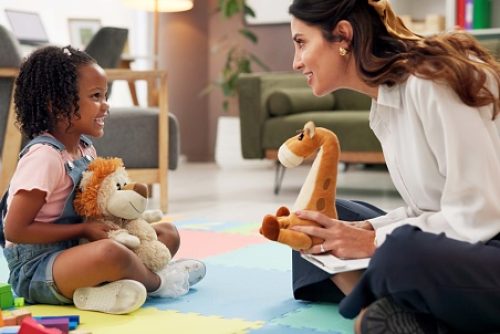
Beginning speech therapy with an experienced neuro-affirming speech therapist can be extremely helpful to support their language development. This can be accomplished by modeling and expanding on the child’s utterance, and encouraging them to form their own novel sentences, thoughts, and ideas.
Under the guidance of a trained and neuro-affirming speech-language pathologist, a child can learn to become more flexible with the language they communicate with. This can be done while adapting and growing to express more novel utterances that express their needs, wants, inner thoughts, and ideas.
How is Gestalt Language Processing Different from Other Forms of Language Processing?
Gestalt language processing (GLP) is how many Autistic and neurodivergent children learn and build foundational receptive and expressive language skills.
Many neurodivergent people learn to process and express language by consuming, organizing, processing, and using their productive language skills in larger chunks.
This differs from the neurotypical population or what we call ‘analytical language processing’ in that these children develop language by processing and learning vocabulary usually by one word at a time, and then slowly learn how to combine these words into short phrases and then meaningful sentences that express their thoughts.
Alternatively, a gestalt language learner learns to process and express language in larger language units or chunks, and then over time they learn how to break those larger language phrases, sentences, and language chunks into novel sentences that express their needs, wants, and ideas in creative ways.
For example, instead of learning a single word, your child may alternatively learn language in whole chunks.
Gestalt language learning means they are processing the language in large chunks and learning to express their wants and desires using whole sentences, phrases, and chunks of learned language information.

It is important to remember that nothing is wrong or bad about this type of learning profile. It’s just another way of learning and processing language.
As your child’s language skills grow and expand, your child will learn to change these language chunks into smaller units and then use those smaller language units to create more novel and unique utterances that express their own ideas and thoughts.
What Are the Signs That My Child is a Gestalt Language Processor?
- Your child often repeats whole phrases or sentences exactly as they are heard.
- Your child communicates using whole phrases and sentences that they have committed to memory.
- Your child may ask the same questions or use the same grammatical structures frequently to communicate their needs to others.
- Your child may experience difficulty and confusion using pronouns or more complex grammatical structures.
- Your child may frequently repeat lines from a favorite show they watch or a game they play to help with language processing and expression.
It is important to note that these phrases may sound extremely complex to the listener. However, the child may be repeating these sentences to improve their understanding of the vocabulary within each phrase or sentence at the beginning of their language development journey.
What Do the Gestalt Language Processing Developmental Stages Look Like?
There are six stages that children generally move through as gestalt language learners and processors.
Stage 1 (Whole gestalts/phrases): This first stage is where your child often communicates in full phrases exactly as they have heard in conversation, songs, or a beloved television show – with no revisions.
‘Let’s go to the store!’
Stage 2 (Mitigated gestalts/phrases): In this second stage, your child begins to shorten and revise parts of memorized language chunks. They may omit words, combine phrases, or slightly revise the language they’ve heard.
‘Let’s go.’
Stage 3 (Single words): At this third stage, your child starts using single words with intent. These are novel words that they choose with meaning, intent and understanding.
‘Store’
Stage 4 (Beginning to use novel vocabulary and grammatical markers spontaneously): During this fourth level, your child is learning to string words together and beginning to form novel thoughts and ideas. At first, these utterances may be short phrases, as they learn to use spontaneous words and vocabulary independently.
‘Go store’
Stage 5 (Advanced and more grammatical structures): As this fifth stage emerges, your child learns to use longer and more grammatically complex sentence structures – using a variety of parts of speech – including nouns, verbs and some early adjectives.
‘Go store, quick.’
Stage 6 (Complex, novel and spontaneous language structures): In this sixth and final stage, your child learns to fully communicate their needs using novel and complex grammatical structures – integrating the whole language learning process.
‘Let’s go to the store, quick’.
In this final stage, your child learns how to form their own meaningful and novel sentences using mature grammatical structures and vocabulary.
It is important to remember that every child’s language development trajectory is unique to them, and these stages of language development should be used as general guidance.
Who Evaluates Language Development and Gestalt Language Processing and Learning?
A speech-language pathologist (SLP) can determine if your child is likely a Gestalt Language Learner. A licensed speech therapist can assess your child’s communication skills and help determine if they are a whole language learner.
Gestalt Language Processing is not a medical condition or diagnosis. It is a descriptive term used to describe how a child processes language.
How Can I Help a Gestalt Language Learner’s Language Development in a Neuro-Affirming Manner?
As a speech-language pathologist, when working with a Gestalt language learner, my goals are shaped around improving the child’s ability to be creative and flexible with their verbal communication skills. Slowly over time improving their ability to produce more novel and grammatically complex utterances and improve language comprehension.
Here are some of my trusted tips and tricks for improving a Gestalt Language Learner’s ability to produce and comprehend more novel and complex language structures over time:
- Encouraging and validating all communication attempts.
- Modeling flexible language – using different vocabulary for the same item.
- Repeating the phrases they produce and then slightly expanding on them or revising them.
- Moving from scripted and memorized speech to more novel utterances that reflect their state or needs.
- Modeling short and meaningful phrases that your child can process and use in their everyday life.
- Respecting and accepting all modes of expression – including gestures, pictures, vocalizations, and words.
- Validating all communication attempts and modalities while also simultaneously helping and supporting your child’s language skills to grow.
- Using everyday activities and moments to build connection and regulation first – through play and fun.
Every child’s communication attempts are meaningful. Always acknowledge, respect, and repeat what they are communicating in a gentle manner. Then, use those beautiful spontaneous moments to validate their communication attempts and use verbal modeling to support their growth and learning further.
Always focus on building connection with your child first and foremost – by encouraging, validating, and accepting all communication modes. All communication starts with regulation and connection first!
Drop in the comments – What’s one of the funniest phrases your child has ever said to you?
I definitely need a good laugh today!
Sincerely,
Heather Lynn Boerner, MA CCC/SLP
Does your child sound like a Gestalt Language Learner?
Chatty Child’s creative speech therapists are here to support and guide you.
Chatty Child’s speech, feeding & occupational therapy can help!
We offer personalized neurodivergent affirming, speech, language, feeding, and occupational therapy, as well as creative mindfulness classes for all ages and abilities.
In-person and online options are available for all therapeutic sessions and classes.
Our speech and occupational therapists are here to support all your child’s therapeutic needs.
I invite you to schedule a tour to discover the support waiting for your child at Chatty Child.
We are here to help and support your child grow and learn!
Let’s create excellent communicators, super eaters, confident voices, calm minds, and limitless possibilities – together!
Begin Speech Therapy for Gestalt Language Processing in NYC
At Chatty Child, we support every child’s unique communication journey. If you’re looking for speech therapy for gestalt language processing in NYC, here’s how to get started:
- Contact us or call 347.491.4451 for a free 15-minute consultation.
- Schedule a comprehensive evaluation to better understand your child’s communication strengths and needs.
- Begin individualized, neurodiversity-affirming speech therapy tailored to your child’s language development.
- Partner with our team to support communication growth at home, school, and beyond.
With the right support from a speech therapist in NYC, your child can continue building meaningful communication skills at their own pace.
Compassionate Therapy Services for Children at Chatty Child
At Chatty Child, we provide individualized, neurodiversity-affirming services that help children build communication, sensory, and life skills for success at home, school, and beyond.
Our services include:
- Speech Therapy – Support for speech, language, and social communication.
- InterAct – Play- and storytelling-based language development.
- Occupational Therapy – Therapy for sensory processing, motor skills, and daily independence.
- hum studios – Mindfulness classes that encourage emotional regulation and self-awareness.
- Teletherapy – Virtual speech and occupational therapy across New York State.
- Functional Nutrition – Nutrition-informed support for overall development and well-being.
- Consulting – Guidance for parents, caregivers, and educators.
- Group Programs – Small-group sessions that build communication and social skills.
Every child has unique strengths and needs. Our team works closely with families to create personalized support that helps children grow with confidence across everyday environments.
Meet Heather: Speech-Language Pathologist in NYC
Heather Boerner, MA, CCC-SLP, is a licensed speech-language pathologist with over 20 years of experience helping children develop communication skills through individualized, neurodiversity-affirming care. As the founder of Chatty Child Speech, Occupational & Physical Therapy, PLLC, she combines evidence-based therapy with trauma-informed and mindfulness-based approaches to support each child’s unique strengths.
Heather is also the author of Carrie the Colorful Chameleon, a children’s book that celebrates identity and self-expression. She provides speech therapy in Tribeca and virtual services for families throughout New York State.
